options-analysisINFYmonte-carlobear-put-spreadquant-tradingimplied-volatilityAI-disruptionAschenbrenner
A 23-Year-Old Bet Against Infosys with $3 Billion. We Ran the Numbers.
Leopold Aschenbrenner's Situational Awareness fund filed SEC puts on Infosys. AI is eating IT services alive. We pulled the option chain, ran 100,000 Monte Carlo simulations, and found exactly one trade that makes mathematical sense.
9 min read
A 23-year-old got fired from OpenAI. Two months later, he published a 165-page manifesto called Situational Awareness: The Decade Ahead predicting AI would surpass human intelligence by 2027. Then he raised a fund, Situational Awareness LP, with a one-line thesis: the real AI winners aren’t chip companies, they’re power plants and data centers.
The Stripe founders (Patrick and John Collison) backed him. Nat Friedman, the former GitHub CEO, backed him. Daniel Gross backed him. The fund’s AUM grew from $225 million to $5.5 billion in under a year. First six months: 47% returns. The S&P 500 did 6%.
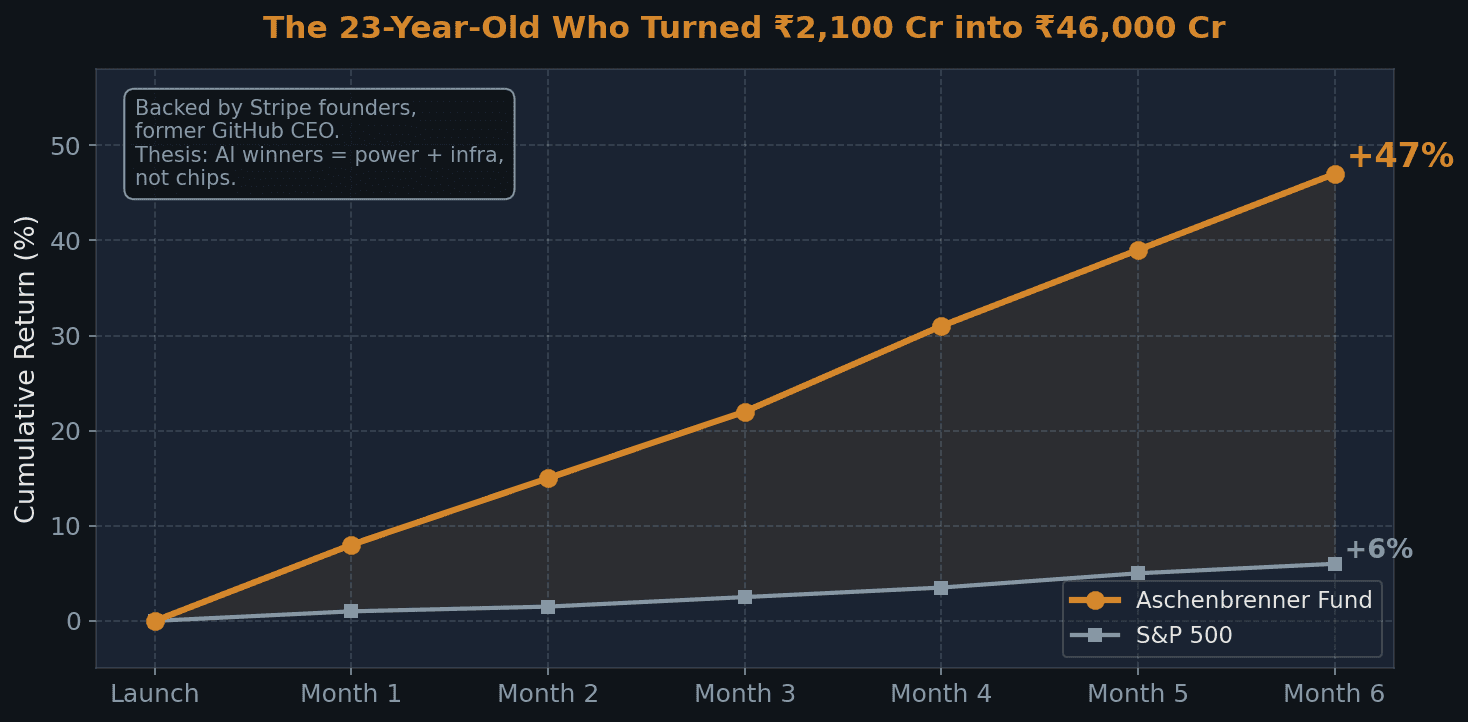 Aschenbrenner Fund vs S&P 500 — 47% returns in 6 months
And then, in his February 11, 2026 SEC 13F filing, one position nobody expected: put options on Infosys covering 500,000 shares.
A put option is a direct bet that the stock goes down. This wasn’t a hedge. This was a thesis, that AI coding tools and LLMs will make the traditional Indian IT outsourcing model obsolete.
So we did what we always do, pulled the live option chain, calibrated Black-Scholes, and ran 100,000 Monte Carlo price paths to see if the trade actually works. Here’s what we found.
Key Takeaways
Leopold Aschenbrenner's Situational Awareness fund filed SEC puts on Infosys. AI is eating IT services alive. We pulled the option chain, ran 100,000 Monte Carlo simulations, and found exactly one trade that makes mathematical sense.
- Why Smart Money Is Betting Against Indian IT
- The Setup: INFY at a Critical Juncture
- The Fear Tax: You’re Overpaying by 52%
- 100,000 Simulations. Zero Sugarcoating.
- The Only Positive-EV Trade on the Board
- Reader Insight: Tighten to 1340/1280 for 3.46x R:R
- The Theta Trap: Why 2 Months Kills Naked Puts
- The Earnings Wildcard: Mid-April Q4 Results
- P&L at Key Price Levels (Per Lot of 600)
Why Smart Money Is Betting Against Indian IT
Before we touch the numbers, you need to understand why the smartest AI investor on the planet would short Infosys.
Infosys’s entire business model is simple: hire Indian developers, sell their time to Western companies at a discount. AI just made that same work available for close to zero.
The evidence didn’t just trickle in, it arrived like a freight train in February 2026:
-
February 4, Anthropic released Claude Cowork, an enterprise AI suite that autonomously handles contract reviews, regulatory compliance, financial modeling, and code generation. The same day, Nifty IT recorded its sharpest single-day crash since March 2020, falling ~6-7% and wiping out ₹2 lakh crore ($24 billion) in market cap. Financial media called it the “SaaSpocalypse.”
-
February 24, Citrini Research published The 2028 Global Intelligence Crisis, a viral report modeling how AI coding agents could cause accelerating contract cancellations at TCS, Infosys, and Wipro. Within hours of circulation, the IT sector shed another ₹84,000 crore. The report now has its own Wikipedia page.
-
February 26, Block Inc (Square, Cash App) laid off 4,000 employees, 40% of its workforce. CEO Jack Dorsey tweeted the full memo. The key line: “We’re already seeing that the intelligence tools we’re creating and using, paired with smaller and flatter teams, are enabling a new way of working which fundamentally changes what it means to build and run a company.” Those were exactly the roles Infosys sells.
-
The damage in numbers: Nifty IT down 21% in February alone. Infosys down ~21%, TCS ~19%, Wipro ~24%. FII outflows from IT: ₹10,956 crore in the first half of February.
-
Infosys itself, for the first time ever, disclosed AI revenue separately in Q3 FY26. The number? Just 5.5% ($275 million). That means 94.5% of their business is still the old model that AI is replacing.
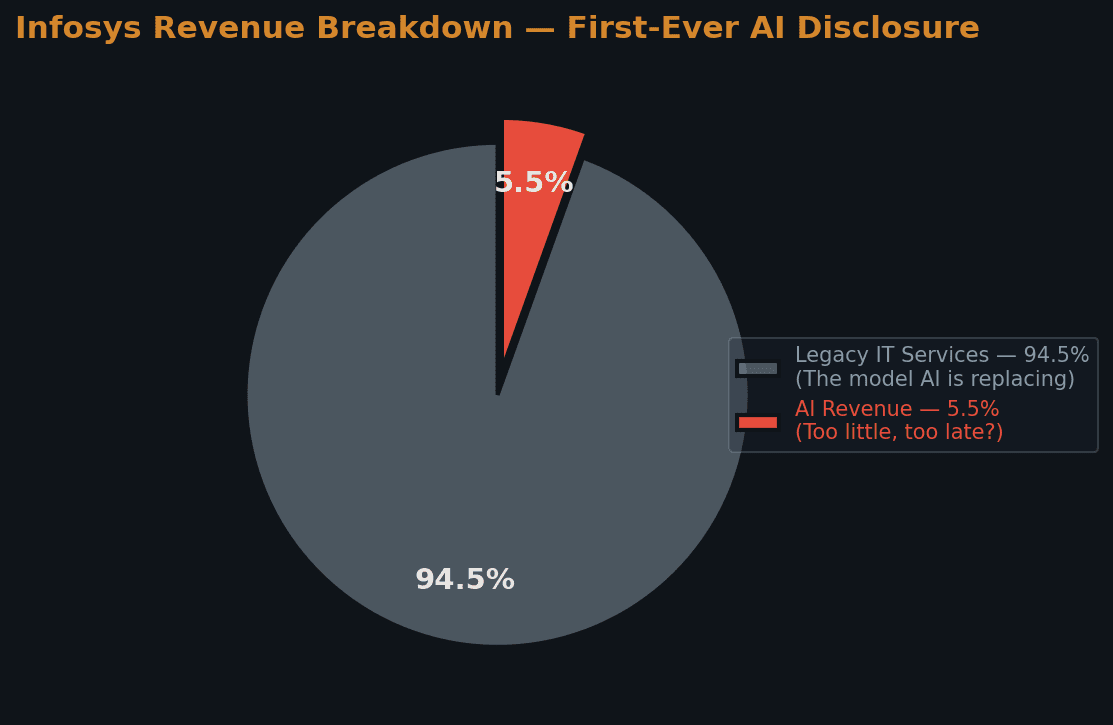 Infosys Revenue Breakdown — 94.5% still legacy IT services
Aschenbrenner filed those puts on February 11, weeks before the Citrini report, before the Block layoffs, before the worst of the selloff. He wasn’t reacting to news. He was front-running a structural shift that the rest of the market is only now waking up to.
The Setup: INFY at a Critical Juncture
INFY closed around ₹1,307 on March 4, 2026, down 25% from its 52-week high of ₹1,733. RSI at 24, screaming oversold. The 52-week low of ₹1,264 is acting as magnetic support.
Naturally, the bearish trade looks tempting. But looking bearish and being a good trade are two very different things.
The April option chain shows elevated implied volatility across the put side. ATM 1300 put: IV of 37.2%. The 1200 put: 39.5%. Deeper OTM strikes push above 41%. That’s a well-behaved put skew, meaning market makers are pricing these efficiently.
No free lunch here. The question is whether you’re getting fair value, or paying a fear tax.
The Fear Tax: You’re Overpaying by 52%
This is where most retail traders get destroyed.
INFY’s trailing 12-month historical volatility is approximately 26%. Even the elevated 30-day HV only reaches about 32%.
The 1200 April put is priced at ₹34 with an IV of 39.5%. That’s a 52% volatility premium over how the stock actually moves.
When we ran Black-Scholes at historical volatility, the fair value of the 1200 put comes out to roughly ₹13. At 30-day HV, it’s about ₹22.
Translation: you’re paying ₹34 for something worth ₹13–22 based on actual movement. The gap goes straight into option sellers’ pockets.
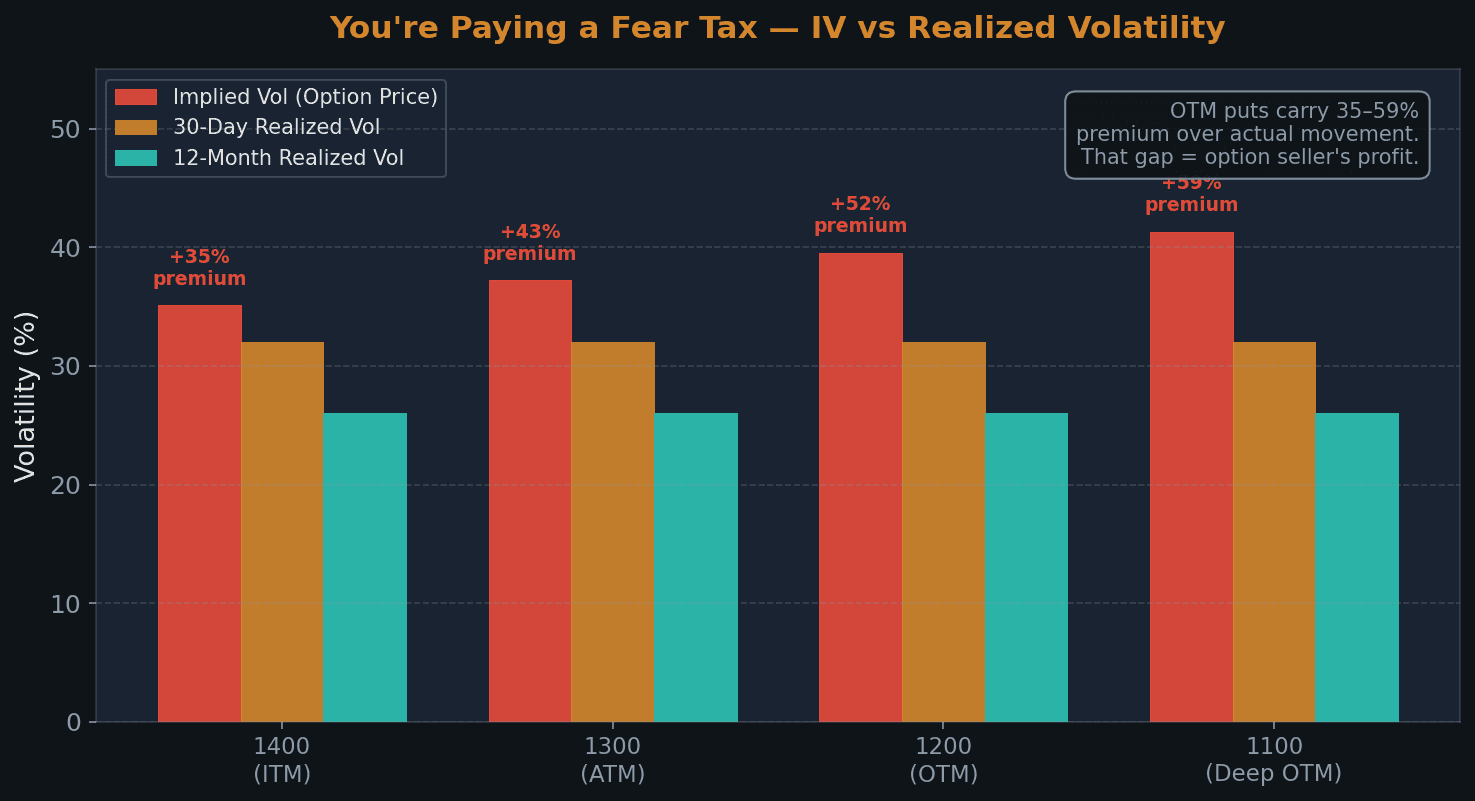 IV vs Realized Volatility across INFY strikes — 35–59% premium
Every single strike on the put chain is overpriced relative to realized vol. The deeper you go OTM, the worse it gets. Market makers aren’t stupid, they’ve already priced in the fear.
100,000 Simulations. Zero Sugarcoating.
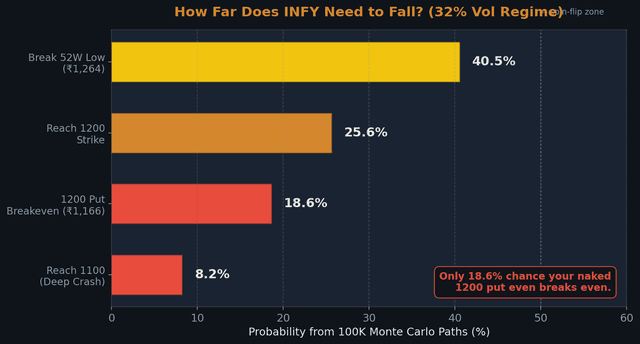
We simulated INFY’s price evolution across four volatility regimes over the 56-day window to April expiry. Here’s the verdict at realistic 32% volatility:
- Probability of breaking the 52-week low (₹1,264): 40.5%
- Probability of reaching the 1200 strike: 25.6%
- Probability of hitting the 1200 put breakeven at ₹1,166: just 18.6%
That last number is the only one that matters for your naked put. INFY needs to crash over 10% from current levels just to break even at expiry.
Win rate: 18.6%. Expected P&L per lot: negative ₹7,373.
The Kelly Criterion, the mathematical framework for optimal position sizing, returns a negative fraction. In plain language: do not allocate capital to this trade.
The Only Positive-EV Trade on the Board
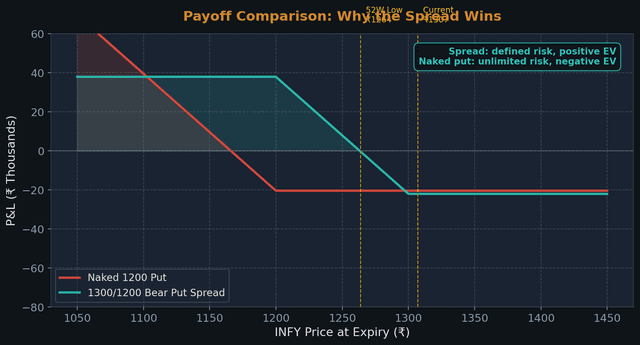
Out of every combination we tested, one structure consistently showed positive expected value: the 1300/1200 Bear Put Spread.
Buy the 1300 put at ₹70.70, sell the 1200 put at ₹34.00. Net debit: ~₹37 per unit. Max profit: ₹63 per unit if INFY closes below 1200 at expiry.
The numbers at 32% vol:
- Win rate: 40.4%
- Expected P&L: +₹310 per lot
- Max profit: ₹37,980 per lot
- Max loss: ₹22,020 per lot
- Reward-to-risk: 1.7x
- Kelly fraction: 1% (thin but viable)
Why does this work when naked puts don’t? The short 1200 leg sells back the overpriced OTM volatility to the market. You’re neutralizing the fear premium instead of paying it. The spread also crushes your theta bleed and protects you from IV crush after earnings.
Reader Insight: Tighten to 1340/1280 for 3.46x R:R
A reader pointed out that tightening the spread to 1340/1280 improves the reward-to-risk ratio from 1.7x to 3.46x while requiring only a 2% move for max profit.
The logic is sound: a narrower spread with strikes closer to spot reduces the net debit and pushes the breakeven higher, which dramatically improves the payout math.
The catch: liquidity. The 1340 strike may have wider bid-ask spreads and lower open interest compared to round-number 1300. Before entering, verify OI and bid-ask width at the 1340 strike, if the spread is more than ₹2–3 wide, slippage eats into the theoretical edge. If you can get clean fills, this is a strictly superior structure.
The Theta Trap: Why 2 Months Kills Naked Puts
If you hold a naked April put until expiry, the math is devastating.
The 1200 put bleeds roughly ₹0.60 per day in theta. Over 56 days, that’s approximately ₹34–36 of time decay, literally more than the entire premium you paid.
Your option goes to zero from theta alone unless a directional move overwhelms the decay. The bear spread reduces this bleed dramatically because the short leg’s theta partially offsets the long leg’s.
Think of it this way: the naked put buyer needs to be right about direction and timing and magnitude. The spread buyer just needs to be right about direction.
The Earnings Wildcard: Mid-April Q4 Results
INFY Q4 earnings typically hit mid-April. This is the make-or-break catalyst.
If guidance disappoints, especially on AI transition progress beyond that 5.5%, the ₹1,264 support shatters and you print on any bearish structure. If results are even slightly positive, IV crushes and the stock bounces, naked puts get destroyed on both delta and vega simultaneously.
The bear spread survives this far better. Our IV sensitivity analysis shows that if IV drops from 39.5% to 25%, a naked 1200 put loses almost all value while the spread barely moves at the midpoint.
JPMorgan has pushed back on the doomsday thesis, saying “It’s overly simplistic to assume that AI can automatically generate enterprise-grade software and replace the value IT services firms create.” But even their defense implicitly acknowledges the threat, the debate is about speed of disruption, not whether it’s happening.
Aschenbrenner’s bet isn’t about one quarter. It’s about the structural decline of the IT services model. Q4 earnings could accelerate or delay that thesis, but the direction is the same.
P&L at Key Price Levels (Per Lot of 600)
Here’s the bottom line at each critical level at expiry:
At ₹1,150 (crash scenario): Naked 1200 put pays ₹9,600. Bear spread maxes at ₹37,980. The spread wins because it captures the full ₹100 width.
At ₹1,200 (strike level): Naked put loses ₹20,400. Spread earns ₹37,980. Massive divergence.
At ₹1,264 (52-week low): Naked put loses ₹20,400. Spread loses only ₹420. Nearly flat versus total loss.
At ₹1,300 (current spot): Both lose, but the naked put loses ₹20,400 versus the spread’s ₹22,020. Similar downside but the spread had a much wider profit zone.
The spread dominates in every scenario except a catastrophic crash below ₹1,100, and even then, the spread’s capped profit is still substantial.
The market is pricing INFY puts at 37–40% implied volatility against 26–32% realized. Every naked put on the chain carries negative expected value.
Leopold Aschenbrenner didn’t bet against Infosys on a whim. He published 165 pages explaining why AI would make the traditional IT services model obsolete, built a $5.5 billion fund around the thesis, and filed his puts before the SaaSpocalypse, before the Citrini report, before Block’s 4,000 layoffs confirmed his logic in real time.
But having the right thesis and making money are two different things.
If you’re bearish INFY through Q4 earnings, the 1300/1200 bear put spread at ~₹37 debit is the mathematically optimal structure. Defined risk. Theta-neutral. IV-crush-resistant. And the only positive-EV trade we found across 100,000 simulated paths.
The question was never just “will Infosys go down.” The question is “am I being compensated for the probability of being right, after accounting for time decay and vol premium?”
On naked INFY puts right now, the answer is no. On the bear spread, the math says yes, barely.
Frequently Asked Questions
- Why Smart Money Is Betting Against Indian IT
- Before we touch the numbers, you need to understand why the smartest AI investor on the planet would short Infosys. Infosys’s entire business model is simple: hire Indian developers, sell their time to Western companies at a discount. AI just made that same work available for close to zero. The evid
- The Setup: INFY at a Critical Juncture
- INFY closed around ₹1,307 on March 4, 2026 — down 25% from its 52week high of ₹1,733. RSI at 24, screaming oversold. The 52week low of ₹1,264 is acting as magnetic support. Naturally, the bearish trade looks tempting. But looking bearish and being a good trade are two very different things. The Apri
- The Fear Tax: You’re Overpaying by 52%
- This is where most retail traders get destroyed. INFY’s trailing 12month historical volatility is approximately 26%. Even the elevated 30day HV only reaches about 32%. The 1200 April put is priced at ₹34 with an IV of 39.5%. That’s a 52% volatility premium over how the stock actually moves. When we
- 100,000 Simulations. Zero Sugarcoating.
- We simulated INFY’s price evolution across four volatility regimes over the 56day window to April expiry. Here’s the verdict at realistic 32% volatility: Probability of breaking the 52week low ₹1,264: 40.5% Probability of reaching the 1200 strike: 25.6% Probability of hitting the 1200 put breakev
- The Only Positive-EV Trade on the Board
- Out of every combination we tested, one structure consistently showed positive expected value: the 1300/1200 Bear Put Spread. Buy the 1300 put at ₹70.70, sell the 1200 put at ₹34.00. Net debit: ₹37 per unit. Max profit: ₹63 per unit if INFY closes below 1200 at expiry. The numbers at 32% vol: Win r
Share this post
Get post alerts in your inbox.
New blog post? We'll email you. No spam, unsubscribe anytime.
Join our Telegram community.
Get post alerts, trading discussions, and market updates.